Thursday, October 21, 2004

Sultan Aminah Hospital - Fungi Infection


THE PARADOX OF FUNGI INFECTION

SAMY VELLU BLAMES HOSPITAL MANAGEMENT
CHUA SOI LEK BLAMES PWD


According to Samy Vellu, the fungus problem at the new $557.8 million Sultan Ismail Hospital in JB was caused by the failure of the hospital management to undertake routine maintenance but Health Minister thinks that the problem was due to structural defects.

The hospital was supposed to be completed on July 29, 2002, but 3-extensions were given due to various problems and was only completed on Nov 14, 2003 and handed over to the PWD on Feb 15, 2004. The Health Ministry took over from the PWD on March 2004 and appointed Pantai Medivest Sdn Bhd to oversee daily maintenance and monitoring of the building supervisory systems, reporting defects and damage to the main contractor. “There was no daily routine checks on the hospital due to lack of staff. The presence of the fungus on the 2nd and 3rd Level of the hospital was due to damage to the air-conditioner valve, which was not reported as there was no building supervisory system,” said Samy Vellu.

However, Dr. Chua said the fungus problem was due to structural defects and not due to delay in routine maintenance. In dismissing Samy Vellu’s report as “Defective” Dr Chua said the fungus was caused by the dampness in the hospital following leakage in its major roof and low human traffic.

“The roof was like a big retention pond,” said Dr Chua. “We (Health Ministry) received the hospital in good faith on March 15 this year but it was full of defects. Besides major leaking problems, there were also problems in the piping system which had affected gas flow and also problem in the sewerage. The problems were made known to the contractor, who had promised to rectify them but did not do so,” Dr Chua said yesterday.

So, who was right and who is wrong????

Actually, both Ministers are right!

Hospital management must make routine inspections and if the air-conditioning valve was damaged and unreported (as claimed by Samy), definitely, it will cause dampness and ultimately leads to fungi growth - SO, SAMY WAS RIGHT! Hurray Uncle Sam.... but.....

Well, at the same time, the roof was a retention pond, there were major leaking problems, piping problems, and sewerage system failures of which the promised restification was not done timely, as claimed by Chua Soi Lek - THEREFORE Dr Chua IS ALSO RIGHT! Yahooooo......but.......

THEN, who is WRONG? Who is the CULPRIT? Is it the CONTRACTOR (MH Project Sdn Bhd) or the HOSPITAL MANAGEMENT SERVICE PROVIDER (Pantai Medivest Sdn Bhd)?

Ironically, both Ministries would not look into the contractual aspects related to the problem. The question arises are:

1) If the health Ministry was not happy with the conditions of the facility of which it was alleged that the works are not conforming to the specifications and standards, then why did they willingly, take over the building? GOOoood FAITHhhhh? Now, it's bad BLOOooooD!

2) If the roof is like a retention pond, (as claimed by Dr Chua), and is leaking badly, it is amusing that PWD had issued a Certificate of Completion (CPC) to the contractor ....... that's professional negligence on the part of PWD engineers.

3) Since taking over the facility by the Health Ministry, how is it contractually managed with regard to Defects Management and the contractual communication related to the Defects Liability Period of the contractor? And how is it that the line of communication seemed to be that the Health Ministry was talking and liaising directly with the main contractor which is not what the contract stipulates - i.e, the contract requires the Superintendent Officer (S.O.) to issue instruction to the main contractor for defects rectification during the defects liability period and failure to respond timely by the contractor, the contract does provide the S.O. to engage others to carry out the work and the cost incurred shall be debited to the contractor. At such, the question that the contractor did not respond to the Health Ministry's Instruction did not arise as the contractor need not take instruction from the Ministry except from the S.O.

In conclusion, the allegation against the contractor is mala fide. The contractor may have done a bad job, but since the employer (i.e. JKR) had accepted the works and issued the CPC, the contractor's responsibility is presumed to have been fulfilled if they did not receive any instructions from the S.O. to make good any defects; and the contractor cannot be held responsible for the damages arising thereof. Morally and socially, the contractor maybe the cause or the contributor to the problem but contractually, he is absolved of the responsibility if the failure on the part of the S.O. to give the necessary instruction did not take place.

Since the Health Ministry had decided to be friendly, and .... have GOOoooD FAITHhhhhh, and had INFACT, contractually accepted to take over the facility, then, they had taken over the contractual responsibility to manage the building and it's associated services; and they must be held fully responsible - for their actions and their decisions. In that sense, when the service management contractor was appointed to manage the building, how could they claimed that it was not their fault that they did nothing except to wait for the main contractor to rectify the defects, which in reality, they should be taking proactive actions to ensure that the building and its services are functioning in accordance with the operation definition. Where is the "Duty of Care" & "Reasonableness" ?????

A Contract is a Contract; Nothing More, Nothing Less!

Every party to the contract must know their role and responsibilities as laid down in the terms and conditions of contract. Every party to a contract must understand their "Rights" and their "Obligations". Each party must also know of the associated risks they will face and the consequences of their decisions and actions that lead to the risk that had happen. Even among the Ministries, there is an unwritten contract of "Duty of Care" and a "Duty to the Rakyat" for spending $558 million on a facility that is malfunctioning and would not serve it's objectives.

The same goes to the Highway problems (MRR2), East-coast Karak Highway shambles, The Langkawi "White Elephants" Schools, and the Matrade Building Debacle. Infact, there are many more systemic failures in Government projects ... computer lab fiascos, PUAS fiascos, Simpang Pulai - Kampung Raja Sloppy slope design (awaiting failures), Gemas Army Barrack project & payment fiascos, Gua Musang- Lojing Highway Slope failing (awaiting failure), Broga landfill project fiascos, et al.

More of these bad news will surface soon and probably, Pak-Lah who had directed the Sports Ministry to form a Cabinet Committee for sports revitalization may also have to form another Cabinet Committee and Advisory Panel to manage the Government Project Management System. The Sports Committee headed by Azalina engaged Hallam Pereira to tell her what our sports officials had already told her predecessors; and so, the Government Project Management committee may also need a foreign consultant to tell them what we local professionals had already known and widely spoken and discussed within the project management community. Is that the Government's way of SOLUTION MANAGEMENT - i.e engage Foreign Consultant, pay through your nose and get a "BLUEPRINT" of our known problems and known solutions and then ARCHIVED the file. IMPLEMENTATION? NAY, NAY, NAY .....oh NO NO NOooooo!!!!!

CAKAP TAK SERUPA BIKIN - MALAYSIA BOLEH LAGI.

Friday, July 16, 2004

No need for PMC & CONSULTANTS


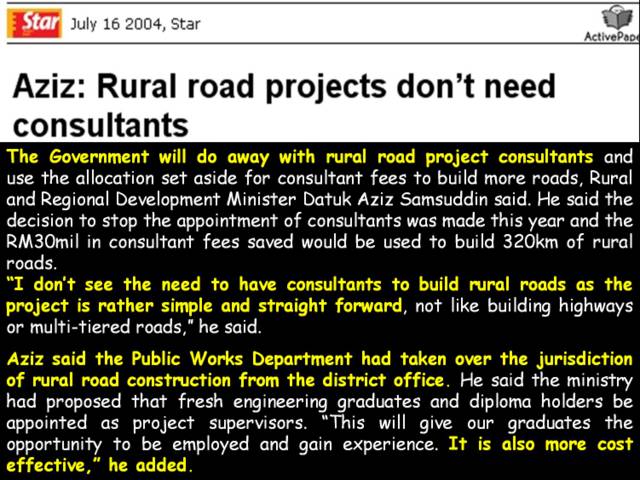
The Government will do away with rural road project consultants and use the allocation set aside for consultant fees to build more roads, Rural and Regional Development Minister Datuk Aziz Samsuddin said. He said the decision to stop the appointment of consultants was made this year and the RM30mil in consultant fees saved would be used to build 320km of rural roads. “I don’t see the need to have consultants to build rural roads as the project is rather simple and straight forward, not like building highways or multi-tiered roads,” he said.

Aziz said the Public Works Department had taken over the jurisdiction of rural road construction from the district office. He said the ministry had proposed that fresh engineering graduates and diploma holders be appointed as project supervisors. “This will give our graduates the opportunity to be employed and gain experience. It is also more cost effective,” he added.
"Consultant, kena cari makanan lain, cara lain, hidup lain."
Don't worry about this news and don't get upset. You can be sure that politicians said one thing and do another. Remember what Pak Lah said earlier about the open tender for all projects? Well, months later, Second Finance Minister says, there will still be negotiated tenders. A clear sign we received recently is the Kuching airport project was just awarded to Ting Pek King few weeks ago. This is the Malaysia Boleh - the cakap bohong boleh! Cakap sia sia sahaja - untuk syok-syok sahaja.

Wednesday, June 16, 2004

CIDB MASTERPLAN


CIDB Masterplan Posted by Hello

CIDB NOW HAS A MASTERPLAN TO SUCK MORE FOR A FEW

After 10 years of existence, we now hear something - A Masterplan. They don't have it before (I presumed). It is encouraging news to hear that CIDB is formulating a Masterplan for the development of the construction industry and it's sustainability towards 2020.

CIDB will be inviting the Presidents & CEOs of the companies involved in the industry to help lay down the final groundwork for the Masterplan at the one day meeting on the formulation of the masterplan.

"ONE DAY IS ENOUGH SIR, TO GET THE FEEDBACK AND STRATEGIES TO DRIVE THE MASTER TO PLAN."

“WE are addressing several issues on the development of the construction sector & its sustainability towards 2020,” says Datuk Hamzah Hasan, the CEO of CIDB.

“The Vision of the Masterplan is to make Malaysia among the best construction industry nations of the world,” he said.

Among the areas covered were sustainable flow of domestic projects, foreign markets and human resources.

Based on his statement and the one-day meeting with Industry captains, what do you figure will come good for the industry?

Before I could comment, lets look at CIDB reasons for existence.

CIDB's motto:
CIDB Malaysia-
Understand The Past,
Conquer The Present,
Shape The Future.


The enactment of the ACT 520 [Lembaga Pembangunan Industri Pembinaan Malaysia Act 1994] has paved the way for the empowerment of CIDB Malaysia to:

1) Create a climate for a more vigorous development in the Construction Industry
2) Carry out its functions as the enabling authority to help Construction Industry Players overcome bureaucratic obstacles
3) Play the role of facilitator by addressing the current and future needs of the Construction Industry.

Roles & Responsibility of CIDB:

1)Carrying out all activities in respect of the Construction Industry
2)Awarding certificates of proficiency
3)Establishing, expanding, promoting the establishment or expansion of companies, corporations or other bodies to carry out activities deemed requisite, advantageous or convenient for or in connection with the performance of its functions
4)Providing financial assistance in the form of loans or otherwise, to persons engaged in the Construction Industry for the purpose of promoting the Industry and providing any guarantees on their behalf
5)Imposing fees or any other charges as deemed fit for giving effect to any of its functions or powers
6)Receiving commission or payments in consideration of any services that may be rendered

REASONS FOR ESTABLISHMENT OF CIDB:

Prior to the establishment of CIDB Malaysia, the Construction Industry was a very segmented and fragmented one where various players were implementing and carrying out their own programs and activities without proper direction and guidance.
This situation has resulted in challenging issues that involved the:

1) Significant decline in construction quality
2) Acute shortage of skilled and unskilled labour, leading to an over-dependency on foreign labor
3) Lack of pertinent statistics and information required for planning, monitoring and decision-making

It was at this juncture, that the Federal Government acknowledged the need to fill a ‘vacuum’ in the Industry, which paved the way for the establishment of CIDB Malaysia as a regulated body entrusted with the responsibility of:

1) Coordinating the needs and wants of the Industry
2) Planning the direction of the Industry
3) Addressing the pertinent issues and problems faced by the Industry
4) Making recommendations in the formulation of policies for the Industry

To fulfill our (CIDB) Vision, 3 key areas have been identified:

1) Setting the stage for Industry Players to embrace new technology
2) Undertaking development and accreditation programs designed to improve construction quality delivery as well as competitive edge
3) Functioning as a gateway for Construction Industry Players to get involved in the international construction marketplace, with the aim of enabling them to earn leadership positions in overseas ventures and maintaining an open exchange of information with construction leaders worldwide.

To achieve our (CIDB)Vision, the 3 key areas have been translated to involve 4 main initiatives:

1) The development of quality services in Construction as a basis for maintaining and improving competitive edge
2) The focus on Construction Technology Development along the lines of new opportunities for innovation and cost effectiveness
3) A “Going Global” initiative that serves to promote and encourage the export of services and products
4) Continuing efforts in terms of reviewing and revising existing rules and policies with the aim of facilitating the development of the Industry

With a far-reaching view of facilitating the Construction Industry towards enhancing Construction business growth potential, CIDB believes that, to trigger development, there is a compelling need to change the way things are being done.
To facilitate that ‘change’, it is imperative to formulate CIDB’s Mission in the light of improving the overall climate of the Construction Industry, thus leading to improvement in standards, skills, technology, manpower and the overall Construction market.

CIDB’s Mission Statement states…

”Together we develop the Malaysian Construction Industry towards Global Competitiveness.”

CIDB'S CORE VALUES:

CIDB’s Value Proposition to the Construction Industry involves a 2-prong perspective –

The first revolves around our focus on relentless efforts on “Adding Value Where It Counts” and
The 2nd perspective encompasses the need to assist the Construction Industry to “Understand its Past, Conquer the Present and Shape the Future”.

CIDB’s objective is to

1) Develop the Construction Industry to be one of the major contributing sectors to the National Economy,
2) capable of producing and delivering high quality construction works,
3) value for money and being responsive to the Nation’s needs.

CIDB’s development framework is derived from the 11 functions:

1) to promote and stimulate the development, improvement and expansion of the construction industry
2) to advise and make recommendations to the Federal Government and the State Government on matters affecting or connected with the construction industry
3) to promote, stimulate and undertake research into any matter relating to the construction industry
4) to promote, stimulate and assist in the export of service relating to the construction industry
5) to provide consultancy and advisory services with respect to the construction industry
6) to promote quality assurance in the construction industry
7) to encourage the standardisation and improvement of construction techniques and materials
8) to initiate and maintain a construction industry information system
9) to provide, promote, review and coordinate training programmes organised by public and private construction training centres for skilled construction workers and construction site supervisors
10) to accredit and register contractors and to cancel, suspend or reinstate the registration of any registered contractor, and
11) to accredit and certify skilled construction workers and construction site supervisors.

These functions have been referenced as a basis for CIDB’s formulation of her corporate initiatives that in turn were translated into:

CIDB Helps The Construction Industry To Explore And Harnesss Overseas Opportunities

NOW LETS ANALYZE:

Has CIDB effort so far (for the last 9 years) be any near their Vision, Mission, Goals & Objectives that were spelt out within their system (as published in their web). CIDB’s contribution to the Construction Industry is demonstrated via…………????? other than the India projects for a selected few crony contractors at the expense of tens of thousands of contributing members? AND CIDB IS FOCUSED INTO THIS POINT OF CONTENTION - THAT IS - GO TO INDIA, SRI LANKA, SUDAN, ETC & GET JOBS FOR CONTRACTOR & EXTRACT MORE FEES FROM THEM (PLUS THEIR OWN POCKET)


ACT 520 was established by the government to paved the way for the empowerment of CIDB Malaysia to:

1) Create a climate for a more vigorous development in the Construction Industry

What is this that CIDB can claim that they have created an environment for a vigorous development in the construction industry? What are the deliverables to-date on the subject point and what have been measured so far, i.e. the key Performance Index?

2) Carry out its functions as the enabling authority to help Construction Industry Players overcome bureaucratic obstacles

3) Play the role of facilitator by addressing the current and future needs of the Construction Industry.


Did CIDB offered any helping hands to thousands of contractors who faced problems such as labor shortages, shortage of building materials such as steel bars, and the problems of labor shortage caused by the deportation of foreign workers by the Government in year 2000? What about the abandon projects and failed projects that affects the livelihood of those purchasers? CIDB collected hundreds of millions of ringgits from contractors of these property development projects and if the purchaser suffers, what has CIDB done to help them - did they talk to the bankers to help suspend the loans for a certain period, help cushion off that period of uncertainty, or initiate actions to restore the project and get it to completion? CIDB only collects money from these projects but contribute nothing to the projects and the stakeholders!!!!!


REASONS FOR ESTABLISHMENT OF CIDB:

The challenging issues as stated, and as the very reason of the existence of CIDB are:

1) Significant decline in construction quality
2) Acute shortage of skilled and unskilled labour, leading to an over-dependency on foreign labor
3) Lack of pertinent statistics and information required for planning, monitoring and decision-making

Out of the 3 areas, what have we achieve thus far? Look into the construction projects and see who are the workers today - basically 99% foreigners consisting of mostly Indonesians, Bangladeshis, Thais and Myanmars. Do we hear of any strategic action by CIDB on how to overcome our dependency on foreign labors? NAYs! Have CIDB build up statistics and information required for planning, monitoring and decision-making necessary to help contractors in tendering and estimating? If it is, there must be available database in the website for contractors info, such as:

1) What is the price of plywood in Perak, Selangor, Johor, Trengganu and how many types and standards are available locally? What have CIDB done to help make plywood more competitively priced? Did they set up agencies to help reduce the price of plywood?
2) What about timber? Each state has different timber price and availability?
3) What about steel bars? Did CIDB talk to Datuk Abu Sahid of Perwaja and get him to commit to supply steel bars to contractors who faced difficulties in getting them, which delayed project completion.

In the SMART Tunnel project, Bakun, SMART School, Computer Lab projects, Did CIDB help contractors to have the opportunity to participate in those project and when the computer lab projects was in trouble, what was the contribution of CIDB?

FUNDAMENTALLY, THE PROBLEM WITH CIDB IS NOT WHAT THEY CAN DO BUT WHAT THEY DIDN'T DO!

Confucius says, "Till you admit that you know what don't not know, you will not achieve profound knowledge."

The Eleven functions set by CIDB that give rise to the formulation of her corporate initiatives which in turn were translated into: CIDB Helps The Construction Industry To Explore And Harnesss Overseas Opportunities - THAT WAS THE SOLE REASON WHICH DEFEAT THE VERY PURPOSE OF THE GOVERNMENT'S INTENTION FOR SETTING UP CIDB IN 1994.

The first question CIDB should consider before putting up the Masterplan is:

"How are the contractors which consists of Class A to Class F plus those in the private sectors (all of them contribute 0.25% of the contract value to CIDB) - How is CIDB going to serve them? What are their needs, what are their weaknesses and what are their lack of knowledge and competencies? What about their financial problems caused by late payment, particularly of Government projects; can CIDB provide them with some financial credit or guarantees to help them get construction materials and pay their labor wages?

There are many Class F, E and Class D contractors, particularly those Bumiputera companies that need assistance in terms of technical expertise and technical informations, including Engineering design knowledge - what can CIDB do for them?

The Mission Statement of CIDB - ”Together we develop the Malaysian Construction Industry towards Global Competitiveness.” is too far fetch; it's more a Vicious Statement than a Mission; The Mission will not be achieve as it is made in DREAMLAND. Does CIDB understand what is Global Competitiveness? Can we compete with Koreans, Japanese, Chinese, Thais? What can CIDB do to prepare the Malaysian contractors to have the competitive advantage over the other international players? What are the statistical datas that Malaysian contractors must know of their international counterparts? What is competitiveness - in terms of cost leadership, branding, uniqueness, product quality, service quality, efficiency, networking and relationship building, strategic partnership, etc? Do we have any measurement standards and benchmarks? Do we have CIDB to do research, regular and continuous research that keeps us inform? Does CIDB having collected Billions of ringgit have a full-time research team - what's the money for, what did they spent it on, where the money?


CIDB’s Value Proposition to the Construction Industry involves a 2-prong perspective – the first revolves around our focus on relentless efforts on “Adding Value Where It Counts” and the 2nd perspective encompasses the need to assist the Construction Industry to “Understand its Past, Conquer the Present and Shape the Future”.

IS THAT WHAT WAS CIDB'S CORE VALUES? ADDING VALUE WHERE IT COUNTS - WHAT VALUES? COLLECTING MONEY FROM CONTRACTORS; ISSUING GREEN CARD TO WORKERS FOR $250? WHAT ARE THE VALUES ADDED FOR THE CONTRACTORS, THE STAFFS & THE WORKERS? CONTRACTORS WHO SENT THEIR STAFFS FOR TRAINING WITH CIDB HAD TO PAY EACH TIME THEY ATTEND THOSE TRAINING - WHY, WHY, WHY? AREN'T THE 0.25% COLLECTION TO BE USED TO PROVIDE TRAINING?

UNDERSTAND OUR PAST (yea, we were weak contractors)
CONQUER THE PRESENT (yea, WE WERE CONQUERED BY CIDB'S GREED & PROFANITY! pay CIDB 0.25% and pay for the green card and training fees)
SHAPE THE FUTURE (Oh, no; got to pay for the Directors' trip overseas and their families and their pension; OH SHIT)

Monday, June 7, 2004

CIDB - The INTERNATIONAL Project KINGMAKER


CIDB FAILED TO SERVE IT'S PAYING CUSTOMERS

Every contractor, big or small has to contribute o.25% of their contract value to CIDB for each and every project they undertake.

Presumably, the contribution required is to finance the DEVELOPMENT & COMPETENCY PROGRAMMES to prepare the Malaysian contractors to achieve quality and efficiency in the field of project management and construction management and to nurture the contractors and the Malaysian construction industry players in general, such that they will be on par to international standards. CIDB was set up by the Mahathir's Government to lead the CHANGE & IMPROVEMENTS. At such, they are held responsible to lead and manage the construction industry in TOTAL.

All the last few years, CIDB had spent it's time and moneys (collected from all the contractors) to set their targets for projects in India, Sri Lanka, etc. This had benefitted some large international corporations such as IJM, Binapuri, Roadbuilders, MMC, Lankhorst, etc, etc. BUT what have all the other contractors benefitted from CIDB's international projects?????? The tens of thousands of paying Class 'F' contractors, Class - E, D, C, B, BX, and many Class 'A' contractors???? Each and everyone of the contractors are contributing to CIDB's coffers, paying for all the expenses incurred and the amount collected is in excess of billions of ringgits. WHAT HAVE CIDB DONE FOR THEM??????

Does Malaysia, particularly the construction sector needs the existence of CIDB? I have asked hundreds of contractors this questions and so far, everyone is affirmative that CIDB has developed into a parasite; a Hirudinea, a "Leech" and a "Pain-in-the ASS".

What has the Government done for the contractors, as far as CIDB is concerned? Why do they collect the hundreds of millions yearly so that they can go to INDIA & SRI LANKA? What has Datuk Hamzah done for CIDB and what has Tan Sri Wan Abdul Rahman (ex-JKR Director General, and now CIDB's Chairman) done to benefit the contractors in the industry, particularly the Class 'B' down to Class 'F' contractors? Some class 'A' contractors did benefit from CIDB (Indian & Sri Lanka projects) but many Class 'A' contractors are not getting anything from CIDB.

WILL PAK-LAH DO SOMETHING ABOUT CIDB & REVAMP THE WHOLE ORGANIZATION? WITH DUE RESPECT TO ALL THOSE IN CIDB, THEY DO NOT DESERVE ANY RESPECT FOR THEY HAVE DONE NOTHING, ABSOLUTELY NOTHING FOR THE INDUSTRY, EXCEPT TO SPENT ALL THE MONIES COLLECTED FOR THEIR TRIPS TO INDIA, SRI LANKA, ETC, ETC.

I HAVE BEEN WITH THE CONTRACTORS FOR MORE THAN 20 YEARS AND I CAN TESTIFY TO WHAT I'VE SAID!!!!! CHALLENGE ME!

Wednesday, May 26, 2004

TELEKOM caused of Old Klang Road Project Delay


Jalan Kelang Lama Project Delayed Posted by Hello

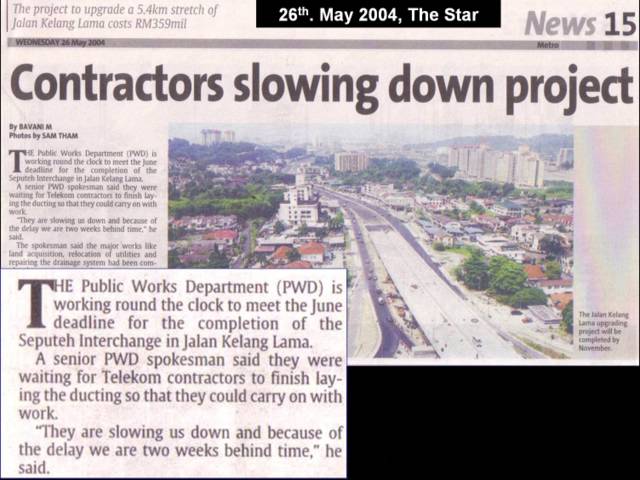
26th. May 2004, The Star report

The roadwork project in Jalan Kelang Lama was reported to be delayed and the delay reason was attributed to the relocation of existing telecommunication services owned by Telekom Malaysia.

Lately, we have heard and read much about the restructuring of the Government Link Companies (GLCs, and the much talk about introduction of performance measurement tools such as KPI, Balance Scorecard, Six Sigma, etc to enhance efficiency and productivity; and it is well-known fact that Telekom Malaysia had over the years, been applying these "effective tools", (especially KPI) to measure their performance. Yet we wonder how effective the tools are, and how did the management measures performance while we often hear of construction project being delayed primarily due to the relocation of existing services and the culprits are Telekom, TNB, Waterworks Department (JBA), DBKL (for KL projects).

On an unrelated issue, I had a problem with my streamyx (not able to access the service, maybe due to my ADSL modem which is under warranty) and I made a report as usual. I was told by their service department that they will need at least one week to sent a technician to resolve my problem (reason is they are too many such problems to attend and limited resources). I begged for help saying that I'm a researcher and will have problem with my day-to-day activities without the service. Fortunately, the technician came the next day and my problem was resolved (Thanks to the good samaritan). Is it common for telekom to take one week to solve problem like this? Is this efficiency and customer service, customer-oriented, customer satisfaction?

The report today (roadworks delay) is not the only one we have heard all these years. If you have been involved with construction projects and JKR road projects, you will understand that these sort of problems have been plaguing the industry players for umpteen years and no improvement had been made so far (Talk to JKR Project Managers and they will verify this). Yet these GLCs still say they had an effective performance measurement system to monitor efficiency, effectiveness and productivity; and they can & want to be world class. I have been involved in construction projects for the last 20 odd years, and I testify to this inefficiencies by the GLCs.

What is efficiency and effectiveness? What is Performance Measurement?; what is Key Performance Index?; What is Balance Scorecard and Six Sigma? Top Management in GLCS talk a lot about it (often made public statement about it - read the News), but do they understand it and do they have a strategic plan to achieve it? CAKAP TAK SERUPA BIKIN! For many Malaysian Contractors, they have learn to live with such inefficiencies and have adapted to the system of incompetence and it has become part and parcel of their construction life.

Some contractors who have political linkage, use their political connection to influence action.Some other contractors who are not so fortunate to rub shoulders with politician (because it is very expensive to rub them; its the truth) uses more innovative actions to solve this problem by "Paying to get Efficient Services" to ensure affirmative action.

Is all this UNKNOWN, UNCOMMON, UNHEARD TO OUR MINISTERS & THE CEOs OF GLCs? (Some of the CEOs of GLCs were with other organization before joining GLCs - they should understand)

COME ON - BE MALAYSIAN & ADMIT THE TRUTH; AFTERALL THIS IS WHAT WE HAVE ADOPTED - THE MALAYSIA-BOLEH PHILOSOPHY!!!!!!!!!